Moving Service Checklist: What’s Included and What Costs Extra
Moving is one of those purchases where the “base price” can look great, right up until the invoice includes stairs, packing materials, a long carry, and a last-minute shuttle.
Moving is one of those purchases where the “base price” can look great, right up until the invoice includes stairs, packing materials, a long carry, and a last-minute shuttle. A solid moving service checklist helps you compare quotes accurately and avoid the most common surprise charges.
This guide breaks down what’s typically included in a professional moving service, what often costs extra, and the exact questions to ask before you book.
Step 1: Identify what kind of moving service you’re buying
Most cost confusion comes from comparing different pricing models (hourly local move vs. long-distance weight or volume pricing) as if they are the same product.
Move type
Common pricing method
What that means for “extras”
Local move (same metro area)
Hourly (crew size + truck)
Anything that increases time can increase cost (stairs, long walk, slow elevators, heavy items).
Intrastate move (within California)
Hourly or flat rate (varies by carrier)
Extra services are often itemized. Verify what assumptions the flat rate is based on.
Interstate move (across state lines)
Weight or volume based, plus accessorials
Many add-ons are standardized as “accessorial charges” (packing, shuttle, storage-in-transit).
For interstate moves, the Federal Motor Carrier Safety Administration (FMCSA) publishes consumer guidance that explains estimates, paperwork, and your rights and responsibilities as a shipper. If you want the official baseline, start with FMCSA’s moving resources.
Step 2: What’s usually included in a professional moving service
Think of “included” items as the minimum needed to legally and safely transport household or office goods. Exact scope still varies by company, so treat this as your verification checklist, not a promise.
The core operational pieces (typically included)
Most professional moves include:
Labor for loading and unloading: The crew loads at origin and unloads at destination.
A moving truck and standard equipment: Dollies/hand trucks and basic moving tools.
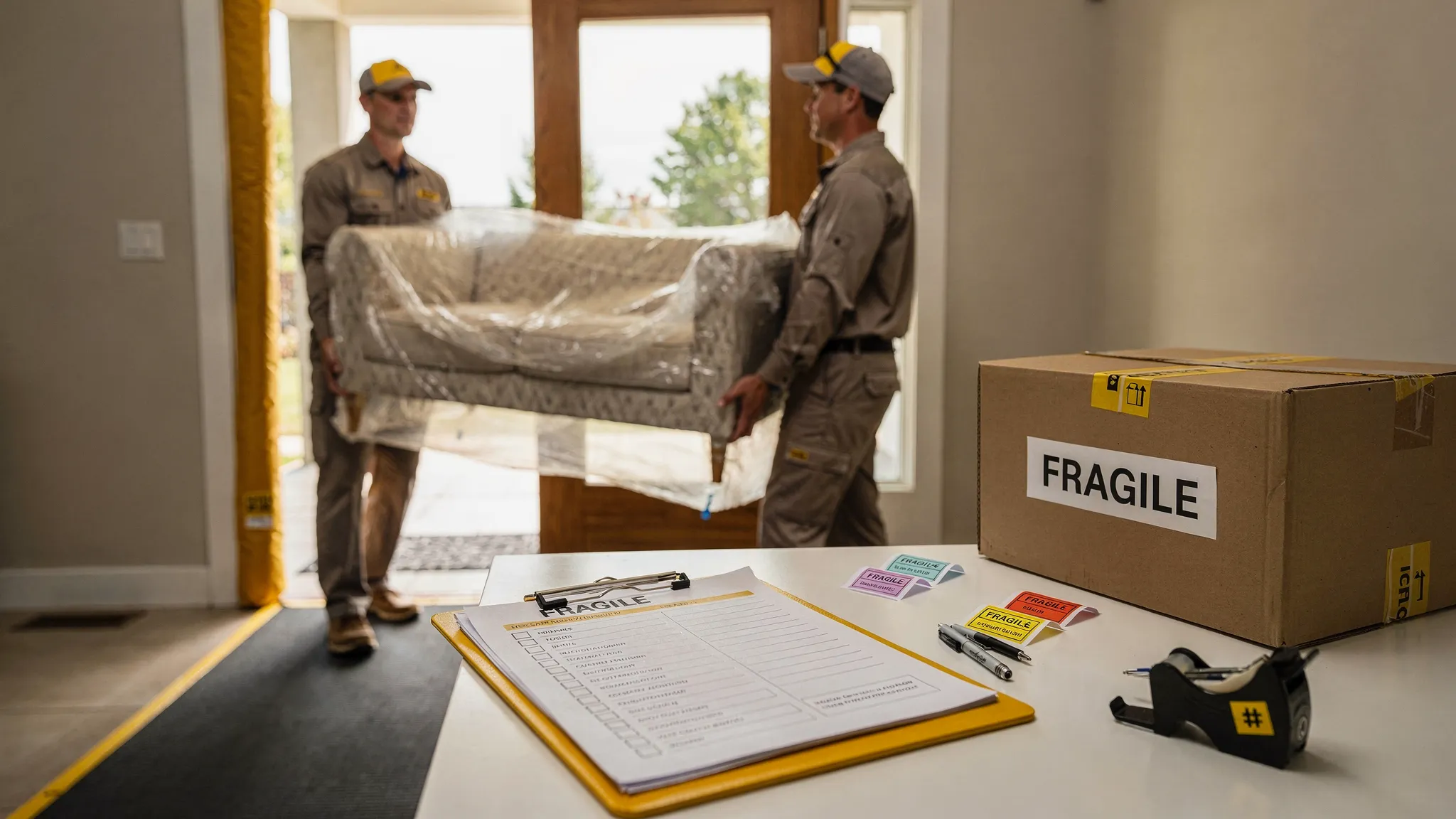
Basic furniture protection: Commonly moving blankets and stretch wrap for standard furniture (confirm what’s protected and how).
Basic disassembly and reassembly: Often limited to “simple” items (for example, bed frames), but this varies widely.
Placement of items in rooms: Standard room-to-room delivery, not necessarily fine staging.
Standard paperwork: Estimate/contract documents, inventory (especially common for long-distance), and payment terms.
What “licensed and insured” should cover (and what it often does not)
Many customers assume “insured” means full replacement coverage for everything. In moving, protection is often handled as valuation (your mover’s liability), and higher coverage options can cost extra.
For interstate moves, FMCSA requires movers to offer released value protection (a minimal, lower-liability option) and provide the ability to purchase higher protection. You should request the valuation options in writing and understand what you are accepting before moving day.
Add-on charges are not automatically “hidden fees.” Many are legitimate costs tied to labor time, risk, or special equipment. The issue is when they are not disclosed early, or when the quote assumptions do not match reality.
Common moving add-ons that increase the price
Potential extra
Why it costs extra
How to reduce the risk of surprise charges
Packing services (full or partial)
Additional labor time, materials, and responsibility for safe packing
Decide what you will pack vs. what you want pros to pack, then list it in the estimate scope.
Packing materials (boxes, paper, tape)
Consumables, delivery, and inventory
Ask whether materials are included, billed at cost, or billed as a package.
Stairs and long carry
More time and higher injury/damage risk
Send photos, count flights, measure walking distance from parking to door.
Elevator delays or building requirements
Waiting time is still paid time on hourly moves
Reserve elevators, get COIs, confirm move windows with management.
Shuttle service
When a large truck cannot access the pickup or delivery location
Measure street access, check low-clearance garages, identify narrow roads in advance.
Specialty items (pianos, safes, large artwork)
Requires specific equipment, trained handling, sometimes extra crew
Provide exact details (weight, dimensions, stairs, tight turns), not just “piano.”
Appliance disconnect/reconnect
Specialized labor and liability (water/gas lines)
Plan for a licensed tradesperson if your mover does not provide it.
Storage (warehouse, storage-in-transit)
Handling in and out, storage fees, and sometimes redelivery charges
Clarify: storage term, access policy, and redelivery pricing before you sign.
Last-minute date changes
Re-routing crews and trucks can create real costs
Ask the reschedule policy and get it in writing.
Extra costs that come from access and logistics (especially in cities)
In dense areas, “access” can be the main cost driver even when the distance is short.
A few common examples:
Tight loading zones, no legal parking, or long distances from curb to door
HOA or building move-in rules (time windows, elevator padding requirements)
Permit or reservation fees for parking or elevator use (usually paid to the city or building, not the mover)
If your move includes major stair carries or heavy lifting, plan for body mechanics and recovery the same way you plan for boxes. If you are relocating to New York City and you want options for post-move back or neck pain support, you can look into an affordable chiropractor in NYC that offers evidence-informed care.
Step 4: The estimate checklist, what to confirm before you sign
A quote is only comparable if you normalize the assumptions. Use this checklist to review any estimate, whether it’s for a local move or long-distance.
Scope checklist (the “what”)
Confirm the estimate clearly lists:
Pickup address and delivery address (including unit numbers)
Move date(s) and arrival window
Inventory assumptions (rooms, major furniture, number of boxes, specialty items)
Included labor activities (packing, disassembly, unpacking, debris removal)
Service boundaries (curb-to-curb vs. room placement vs. full-service)
Pricing checklist (the “how the money is calculated”)
Make sure the quote states:
Pricing type (hourly, flat rate, weight/volume based)
Minimum hours (if hourly) and when the clock starts/stops
Travel time policy (local moves commonly include some travel billing)
Overtime rules (if a job runs long)
Deposit amount (if any) and refund/cancellation terms
Accepted payment methods and when payment is due
Protection checklist (the “what happens if something goes wrong”)
Ask for:
The valuation option you are selecting (and the cost if upgraded)
Claim filing timeline and documentation requirements
What is excluded (for example, self-packed boxes may have different coverage rules)
FMCSA’s consumer materials are helpful here because they outline the documents you should receive for interstate moves and what those documents mean.
Step 5: Moving-day checklist to prevent “extra time” charges
Most extra charges on local hourly moves are really extra hours. The easiest savings often come from removing friction.
Prep your home so the crew can work continuously
Clear hallways and remove trip hazards
Pre-pack small items and loose decor (unless you are paying for packing)
Empty drawers that will be carried, if your mover requires it
Set aside items that do not move (and label them clearly)
Prep access so the truck can park and load fast
Reserve elevators and loading zones if needed
Confirm parking instructions and gate codes
Have a plan for pets and children so doors stay closed and paths stay clear
Do a fast walkthrough that prevents mistakes
Before the first box is lifted:
Point out fragile items, tight turns, and items that need special handling
Confirm what is going and what is staying
Confirm the destination room labels and placement plan
A simple rule for comparing movers without guesswork
If two moving services have different totals, the right question is not “Who’s cheaper?” It’s:
Which estimate has the most complete scope with the fewest assumptions?
A higher quote that explicitly includes packing materials, stairs, and valuation can be a better value than a lower quote that leaves those items out.
When you want clarity upfront
Zapt Movers provides residential, commercial, packing, storage, and long-distance moving options in California with upfront honest pricing and licensed, insured service. If you want a quote that’s easier to compare because the scope is clear, you can request a free estimate directly from Zapt Movers.
Let’s Make Your Next Move Effortless and Worry-Free
Get a free, no-obligation moving quote in under 60 seconds. Our team is available 7 days a week to answer your questions and help you plan the perfect move. Call us, fill out our form, or book online — we’ll take it from there.
Let’s Make Your Next Move Effortless and Worry-Free
Get a free, no-obligation moving quote in under 60 seconds. Our team is available 7 days a week to answer your questions and help you plan the perfect move. Call us, fill out our form, or book online — we’ll take it from there.
Let’s Make Your Next Move Effortless and Worry-Free
Get a free, no-obligation moving quote in under 60 seconds. Our team is available 7 days a week to answer your questions and help you plan the perfect move. Call us, fill out our form, or book online — we’ll take it from there.