
Professional Movers
Professional Movers: What to Expect and What to Ask
Hiring professional movers can feel like a relief until you realize how many details can change the final price, the timeline, and even whether your items arrive intact.

Professional Movers
Hiring professional movers can feel like a relief until you realize how many details can change the final price, the timeline, and even whether your items arrive intact.
Hiring professional movers can feel like a relief until you realize how many details can change the final price, the timeline, and even whether your items arrive intact. The good news is that reputable movers follow a fairly consistent process, and when you know what to expect, you can spot quality quickly and avoid surprises.
This guide walks you through the typical moving workflow (from estimate to delivery) and gives you the most important questions to ask, organized by category, so you can compare companies confidently.
At a minimum, professional movers should provide clear communication, trained labor, the right equipment, and a written estimate that matches the scope of your move. Beyond that baseline, what’s “included” varies a lot by company and by move type (local vs. long-distance, residential vs. commercial).
Here’s a practical way to think about it: you’re not just hiring a truck and a crew, you’re hiring a system.
Area | What pros typically do | What you should confirm in writing |
|---|---|---|
Estimating | Gather inventory, access details, dates, and special items | Estimate type, assumptions, included services, add-on rates |
Protecting your home | Use floor runners, door jamb protection, blankets, wrap | What protection is included, and for which surfaces |
Protecting items | Pads/blankets, stretch wrap, disassembly as needed | How furniture is protected, what counts as “specialty” |
Loading strategy | Stage items, balance the truck, label and track rooms | How they label, how they handle fragile/high-value items |
Timing | Provide arrival window and job plan | On-time policy, delay communication, long-distance delivery window |
Payment | Explain deposit (if any), accepted payment types | When payment is due, forms accepted, refund/cancellation terms |
Problem resolution | Document issues and explain claims steps | Claims timeline, required documentation, valuation options |
If you want a quick baseline for consumer protections and common scam patterns (especially for interstate moves), the FMCSA’s Protect Your Move resources are worth reviewing.
Movers price uncertainty. The more clarity you provide, the more stable your quote tends to be.
Before you call anyone, prepare:
Move date(s) and any flexibility
Addresses and unit details (stairs, elevator reservations, long hallways)
Parking/loading constraints (busy street, permits, loading docks)
A realistic inventory (especially large furniture and fragile items)
Any specialty items (piano, safe, artwork, antiques, server racks)
A common frustration is receiving a low quote that later jumps because the mover “didn’t know” about access issues or extra pieces. The cure is simple: document your reality up front.
A professional estimator should ask follow-ups and pressure-test the plan. That is a good sign.
Expect them to cover:
Inventory and what’s included (garage, patio, storage unit)
Packing needs (full, partial, fragile-only)
Disassembly/reassembly expectations
Access time (elevator rules, HOA move-in windows)
Long carry or shuttle needs if a large truck can’t reach your door
If you feel like you’re being rushed into a number without details, that’s often a clue the quote is more marketing than planning.

Professional movers should provide written documentation of:
Dates and arrival window
Origin and destination addresses
Services included (labor, truck, packing, materials, storage)
Pricing structure (hourly, flat, binding, not-to-exceed)
Add-on charges and when they apply (stairs, long carry, bulky items)
Valuation/coverage options
If anything you discussed is missing, ask for it to be added. Verbal promises do not help when there’s a dispute.
A solid moving day usually starts with a quick walkthrough led by the foreperson or lead mover. This is where you confirm what is going, what is not going, what needs special handling, and what gets staged first.
Common “pro” behaviors you should see:
The crew introduces the lead and confirms scope before lifting
Floors/doorways are protected before major traffic begins
Furniture is padded and wrapped before loading
Boxes are kept upright and rooms are kept separated when possible
The lead checks in if anything changes (time, route, extra packing)
Professional movers typically unload by room, based on labels or your guidance, then do a final walkthrough.
Your job during this phase is to:
Direct placement (especially for heavy pieces)
Inspect obvious damage while the crew is still present
Confirm nothing was left on the truck
If something looks off, note it immediately and take photos. It’s much easier to resolve issues when documentation starts the same day.
Even good moves can have accidents. What matters is whether the company has a clear, documented process for reporting and resolving damage or loss, including timelines and what proof is needed.
Instead of firing off 30 questions at once, use categories. It keeps the conversation efficient and helps you compare companies apples-to-apples.
Category | Question to ask | What you’re looking for |
|---|---|---|
Licensing | “Are you licensed for my type of move (in-state CA vs. interstate), and what’s the license/USDOT info?” | They can clearly explain authority and provide verifiable IDs |
Insurance and valuation | “What valuation options do you offer, and what’s the claims process and timeline?” | Plain-language explanation, written terms, no dodging |
Carrier vs. broker | “Will your company perform the move with your crew and truck, or are you brokering it?” | Clear confirmation of who is physically handling your shipment |
Estimate type | “Is this estimate binding, non-binding, or not-to-exceed, and what assumptions could change it?” | Direct answer plus a list of scope triggers |
Pricing detail | “What exactly is included in the base price, and what counts as an extra charge?” | Itemized, repeatable rules, not vague assurances |
Deposits | “Do you require a deposit, and what is the cancellation or reschedule policy?” | Transparent terms that don’t feel punitive |
Timing | “What’s the arrival window and, for long-distance, what’s the delivery window?” | Specific windows and proactive communication expectations |
Crew and training | “Are movers employees or contractors, and how is the crew assigned?” | Consistent staffing practices, not last-minute mystery crews |
Equipment | “What equipment do you bring for stairs, tight hallways, or heavy items?” | Dollies, straps, pads, tools, and a plan for your constraints |
Packing | “If I add packing, is it full, partial, or fragile-only, and are materials included?” | Clear scope, clear material policy |
Specialty items | “How do you handle items like pianos, safes, art, or large TVs?” | A defined method, potential extra cost explained upfront |
Storage | “If I need storage, what are the access rules, billing, and protection measures?” | Storage terms in writing, access expectations clarified |
Ask: “What are the top three reasons a move like mine ends up costing more than expected?”
A professional answer usually includes common scope changes like access issues, added items, packing added late, or longer-than-expected carry distance. If the answer is “That never happens,” be cautious.
Not every issue is a deal-breaker, but these are consistent warning signs across the industry:
The company won’t provide licensing details, or the business name doesn’t match what’s on the paperwork
You’re pushed to pay a large deposit immediately, especially by cash or wire
The estimate is vague (no scope assumptions, no add-on rules)
The mover refuses walkthroughs (virtual or in-home) but still claims the quote is “guaranteed”
Communication is sloppy before booking (it rarely improves on moving day)
They can’t explain valuation/claims in plain language
Two quotes can look similar and still be priced on completely different assumptions. The goal is to normalize the scope.
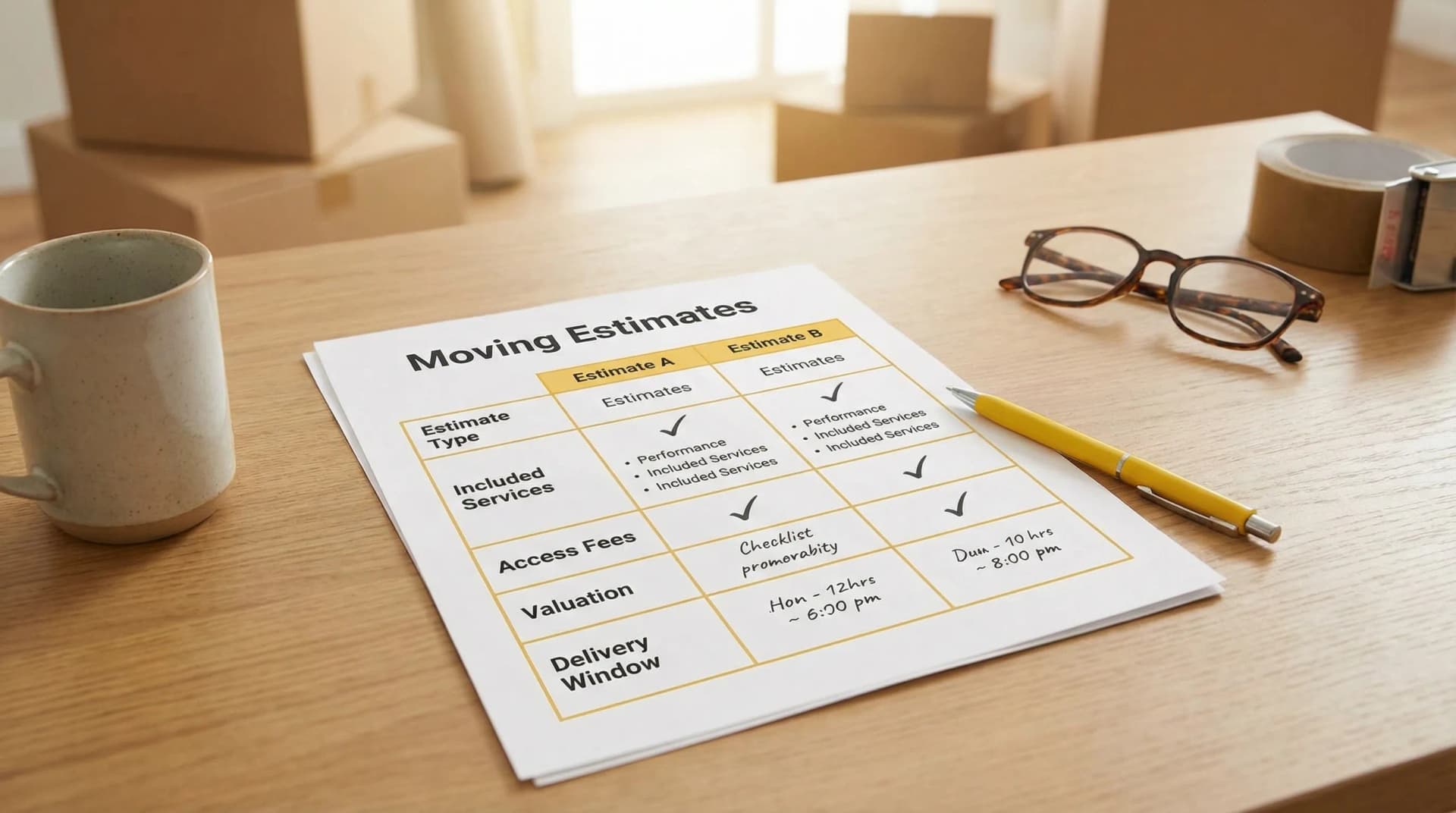
Use this checklist-style comparison table when you review estimates:
Line item to compare | Why it matters | What to verify |
|---|---|---|
Estimate type | Controls price changes | Binding vs non-binding vs not-to-exceed |
Labor model | Drives total cost on local moves | Hourly rate, minimum hours, travel time policy |
Packing scope | Big swing factor | Full/partial/fragile-only, materials included or separate |
Accessorials | Common “surprise” charges | Stairs, long carry, elevator, shuttle, bulky items |
Valuation | Affects risk and claims | Coverage level, deductible, how claims are filed |
Timing | Impacts logistics and risk | Arrival window, delivery window, peak-date pricing |
If you’re trying to keep your move on-budget, it also helps to track moving expenses like deposits, packing supplies, utility transfers, and storage in one place. For budgeting and money organization ideas that pair well with big life transitions, you can browse the FIYR personal finance blog and adapt their tracking approach to your moving budget.
Even with great movers, the home setup can add time. A few practical preparations often reduce labor hours and lower the chance of damage.
Focus on logistics, not perfection:
Reserve elevators and loading docks if you’re in an apartment or office building
Confirm parking rules and permits (especially in dense CA neighborhoods)
Clear a wide pathway from door to main rooms
Set aside “do not move” items in a closed room or clearly marked area
Separate valuables and essentials you’ll transport yourself
Have a decision-maker onsite who can answer questions quickly
This doesn’t replace packing guidance, but it makes the moving crew dramatically more efficient.
How far in advance should I book professional movers? For peak seasons (late spring through summer) and end-of-month dates, booking several weeks ahead is common. If your date is flexible, you may find more availability and better pricing.
Do professional movers disassemble and reassemble furniture automatically? Sometimes basic disassembly is included, sometimes it’s an add-on. Ask exactly what items they will disassemble, and whether reassembly at delivery is included in the quote.
What information do movers need to give an accurate estimate? Inventory, addresses, move date, access details (stairs, elevator, long carry), packing needs, and any specialty items. Missing access details are a frequent cause of price changes.
Should I choose a binding or non-binding estimate? It depends on your move type and risk tolerance. The best choice is the one that clearly defines scope and explains what can change the price. Ask the mover to explain the estimate type in writing.
How do I know if I’m hiring a broker or the actual moving company? Ask directly who will physically perform the move, and confirm that the business name on the estimate matches the company that will show up with the truck and crew.
What should I do if something is damaged during the move? Document it immediately with photos, note it before the crew leaves if possible, and follow the mover’s written claims process. Keep packing materials for damaged items until the claim is resolved.
If you want a move that’s planned clearly, priced honestly, and handled by a licensed and insured team, Zapt Movers can help with residential, commercial, local, long-distance, packing, and storage services.
Request a free quote at Zapt Movers and share your inventory and access details so your estimate reflects the real scope from the start.