Moving Company Long Distance: How Rates Are Calculated
Long-distance moves feel expensive for one simple reason: you are paying for transportation plus logistics. Two people can move the same number of bedrooms across a similar distance and still receive very different quotes because the details that control labor time, truck space, risk, and scheduling are rarely identical.
Long-distance moves feel expensive for one simple reason: you are paying for transportation plus logistics. Two people can move the same number of bedrooms across a similar distance and still receive very different quotes because the details that control labor time, truck space, risk, and scheduling are rarely identical.
This guide breaks down how a moving company long distance rate is typically calculated, what fees are legitimate, and what to ask for so you can compare quotes accurately.
Interstate move (crossing state lines): Regulated at the federal level. Movers must follow Federal Motor Carrier Safety Administration (FMCSA) consumer protection rules.
Intrastate move (staying within the same state): Pricing and licensing depend on the state. In California, household goods carriers are overseen by the California Public Utilities Commission (CPUC).
Why it matters: interstate estimates, paperwork, and valuation options follow FMCSA requirements, while intrastate moves may follow different estimate formats and tariff rules.
If you are comparing companies, confirm whether you are hiring the actual carrier or a broker, and verify licensing. For interstate movers, you can use the FMCSA database: Search a mover’s USDOT number.
The core cost drivers behind long-distance moving rates
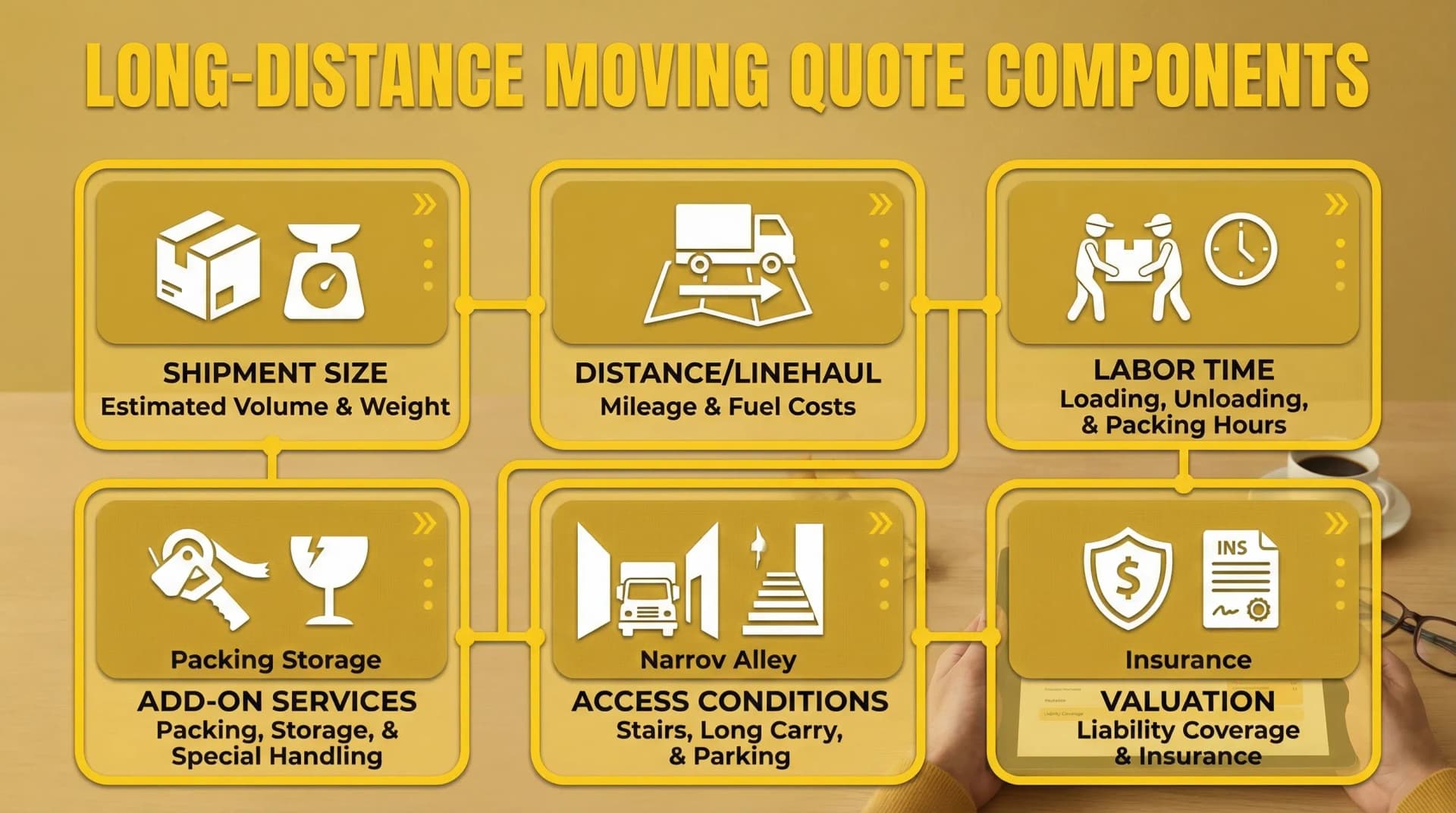
Most long-distance quotes boil down to three “big buckets,” with add-ons layered on top:
Shipment size (weight and or volume)
Distance and routing (linehaul transportation)
Labor and handling time (loading, unloading, and logistics)
Different companies express these in different ways, but the underlying math is usually very similar.
1) Shipment size: weight, volume, and how space is measured
On a long-distance move, your stuff is the product being transported. The more you ship, the more it costs.
Depending on the mover and the type of move, size may be priced using:
Weight-based pricing: Common for interstate household goods moves.
Volume or space-based pricing: Common when trailer space is the limiting factor, or for certain long-distance models.
Inventory-based pricing: A detailed item list (often paired with a visual survey) that predicts weight and labor.
How movers estimate size:
In-home survey: A walk-through where the estimator notes inventory and access conditions.
Virtual survey: A video walkthrough or photo-based inventory. When done carefully, this can be very accurate.
Self-reported inventory: Fast, but the most likely to be off if you forget storage areas, garage items, or outdoor furniture.
What causes “quote shock” later: If the shipment is larger than the estimate, pricing can change, especially on non-binding estimates (more on estimate types below). The single best way to control long-distance cost is to make sure the inventory and scope are correct before move day.
2) Distance and routing: linehaul is more than “miles x rate”
Long-distance transportation (often called linehaul) accounts for:
Dispatch and routing
Driver time and compliance limits
Fuel and tolls (and sometimes ferry fees)
Equipment wear and staging
Delivery scheduling (direct delivery vs consolidated routes)
Two moves with the same mileage can price differently if one route has higher tolls, seasonal weather constraints, or requires a different truck plan.
3) Labor time: the hidden multiplier in long-distance quotes
Even when transportation is the headline, labor often determines whether a move stays on-budget.
Labor costs are driven by time, and time is driven by conditions such as:
Stairs and elevators
Long carries (parking far from the door)
Tight hallways or difficult furniture disassembly
Large fragile items requiring special handling
Building rules (move windows, COIs, elevator reservations)
Long-distance moves typically require labor at origin and destination, plus potential labor for packing, crating, or storage handling.
Common add-ons (accessorials) that legitimately change the price
Many “extra fees” are not scams. They are charges for real extra work, extra equipment, or extra risk. The problem is when they are not disclosed upfront.
Here are the add-ons that most often change long-distance moving rates.
Add-on (accessorial)
What triggers it
How to reduce or avoid it
Packing services
Full packing, partial packing, fragile-only packing
Pack yourself (carefully), or limit packing to fragile rooms
Reserve close parking, arrange loading zone permits when needed
Shuttle service
A tractor-trailer cannot access the property
Confirm truck access, measure street width, note steep driveways
Bulky or specialty items
Pianos, safes, large glass, artwork, fitness equipment
Disclose early, ask what handling and protection is included
Storage-in-transit (SIT)
Delayed delivery, closing gaps, temporary storage
Align move-in dates, plan a storage window in writing
Extra stops
Picking up or dropping off at multiple addresses
Combine stops when possible, confirm stop fees ahead of time
If a quote looks unusually low, it often excludes one or more of these items. That is why comparing offers “apples to apples” matters.
Valuation (often mislabeled as “insurance”): how protection affects price
For interstate moves, movers must provide valuation options and explain liability. The FMCSA’s consumer resource hub is a solid reference point: Protect Your Move.
Two common valuation levels you will hear:
Released value (basic liability): The lowest-cost option, but limited protection.
Full value protection: Higher protection level, typically costs more.
Important: This is one of the biggest differences between two quotes that otherwise look identical. If Company A includes higher protection and Company B does not, the cheaper quote may not be cheaper in a meaningful way.
Estimate types: why the “kind of quote” matters as much as the number
For long-distance moves, the estimate type determines how much the final price can change.
Estimate type
What it generally means
Best for
Binding estimate
Price is based on the listed scope. Changes typically require a written change order or revised agreement.
People who want predictability and a clearly defined scope
Non-binding estimate
Final charges can change based on actual weight, services, and conditions.
People comfortable with variability if inventory is uncertain
Not-to-exceed (guaranteed not to exceed)
Price will not go above the estimate for the listed scope, but can go down if weight or services are less.
People who want a ceiling but also want upside if shipment is smaller
If you want fewer surprises, focus on getting the scope right and insisting on a written, itemized estimate that spells out what is included and what triggers extra charges.
A realistic example of how a long-distance price changes (illustrative only)
Below is a simplified illustration to show why quotes diverge. Numbers are placeholders only, because real pricing varies by market, date, inventory, access, and carrier capacity.
Quote component
Example scenario A
Example scenario B
Transportation (linehaul)
$3,200
$3,200
Labor at origin and destination
$1,400
$1,900 (stairs + long carry)
Packing service
$0 (customer packed)
$900 (kitchen + fragile)
Specialty item handling
$0
$250 (treadmill disassembly)
Valuation upgrade
$0
$300
Total (illustrative)
$4,600
$6,550
Both moves could be the “same distance.” The difference comes from time, complexity, and risk.
What a transparent long-distance quote should include
A professional long-distance estimate should make it easy to answer:
What inventory and services are included (and excluded)
Whether packing materials are included
Access conditions assumed (stairs, elevators, long carries)
Shuttle and long-carry triggers (and how they are measured)
Valuation level and deductible terms (if applicable)
Are long-distance moving rates based on miles or weight? Most long-distance pricing reflects a combination of shipment size (often weight or space) and transportation distance, then adds labor, access, and optional services like packing or storage.
Why do two movers give very different long-distance quotes for the same move? The difference usually comes from what is included. One quote may exclude packing, shuttle needs, long-carry assumptions, valuation upgrades, or may be based on a smaller estimated inventory.
What fees should raise a red flag? Vague “miscellaneous” charges, missing licensing information, cash-only demands, or a quote that is not backed by a written, itemized scope are common warning signs. For interstate moves, you can verify licensing through FMCSA tools.
Is a virtual walkthrough accurate for long-distance pricing? It can be, if you show all rooms, closets, the garage, and large items, and you disclose access constraints. Accuracy drops when storage areas or bulky items are skipped.
How can I avoid surprise charges on a long-distance move? Get a written estimate, confirm the estimate type (binding, non-binding, not-to-exceed), make sure inventory is complete, and ensure accessorial triggers (stairs, long carry, shuttle, storage) are spelled out.
Do long-distance movers include “insurance” in the price? Movers typically include a basic liability level and offer higher valuation options at added cost. Ask what level is included and what upgrades are available.
Get an upfront long-distance quote you can actually compare
If you are planning a long-distance move in or from California and want a quote that clearly explains what drives the price, Zapt Movers can help with licensed and insured service, careful handling, and upfront honest pricing.
Request a free quote from Zapt Movers and ask for an itemized breakdown so you can compare your options confidently.
Let’s Make Your Next Move Effortless and Worry-Free
Get a free, no-obligation moving quote in under 60 seconds. Our team is available 7 days a week to answer your questions and help you plan the perfect move. Call us, fill out our form, or book online — we’ll take it from there.
Let’s Make Your Next Move Effortless and Worry-Free
Get a free, no-obligation moving quote in under 60 seconds. Our team is available 7 days a week to answer your questions and help you plan the perfect move. Call us, fill out our form, or book online — we’ll take it from there.
Let’s Make Your Next Move Effortless and Worry-Free
Get a free, no-obligation moving quote in under 60 seconds. Our team is available 7 days a week to answer your questions and help you plan the perfect move. Call us, fill out our form, or book online — we’ll take it from there.