
Moving Companies
Relocation Moving Companies: How to Compare Services
When you search for relocation moving companies.

Moving Companies
When you search for relocation moving companies.
When you search for relocation moving companies, you will find plenty of “full-service” promises and “low” quotes that look similar on the surface. The difference shows up later, when the crew arrives late, the scope changes, or the contract leaves you paying for surprises.
This guide gives you a simple, apples-to-apples way to compare movers, so you can choose based on service fit, risk, and total cost, not just the headline price.
Before you compare companies, you need a consistent “move profile” that every mover is pricing.
At minimum, prepare these details:
Origin and destination addresses (or at least zip codes), including apartment/unit info
Move date window (exact date if you have it, plus any flexibility)
Home size and inventory (number of rooms is not enough for accuracy)
Access constraints (stairs, elevators, long carry distance, parking limitations, narrow streets)
Special items (pianos, safes, oversized sectionals, fine art, large TVs)
Service level (labor-only, partial packing, full packing, storage needed or not)
If you want a deeper walkthrough on the quote side, Zapt Movers has a practical companion guide on what to provide and why it affects accuracy: Local movers quote: how to get an accurate estimate.
Price matters, but it should be the final filter, not the first. Use these categories to compare services with less guesswork.
A carrier performs the move with its own crew and truck. A broker sells the job, then assigns it to another company.
Why it matters: accountability, claims handling, and communication can get complicated when the company you book is not the company that shows up.
Practical check:
Ask, “Are you the carrier performing the move, or a broker?”
Confirm the legal business name matches the paperwork and the license records.
Legit relocation movers should be properly licensed for the type of move:
Interstate moves typically require USDOT registration and compliance with federal rules.
In-state California moves are regulated differently (intrastate authority).
Start here for consumer guidance and verification resources: FMCSA Protect Your Move and the California Public Utilities Commission.
If you want a clear explanation of what “licensed and insured” should mean in practice, this article breaks down the categories to look for: Professional moving companies: what “licensed and insured” means.
Relocation quotes often fall apart because of scope gaps. The key is not just the estimate type, it is how the company defines “included.”
Compare these items on every quote:
What is included (labor, truck, furniture protection, disassembly/reassembly)
What triggers extra charges (stairs, long carry, bulky items, packing materials, waiting time)
How changes are approved (written change order, photo documentation, updated inventory)
If a mover cannot explain how changes are handled, you are betting your budget on ambiguity.
Two quotes can show the same total, but behave very differently under stress.
Focus on:
Hourly vs. flat/binding style pricing (and what conditions can change it)
Deposits (how much, when due, and refund rules)
Payment methods (card, ACH, etc.) and whether “cash-only” is pushed
A healthy sign is upfront, honest pricing paired with clear terms. An unhealthy sign is a low number with vague inclusions.
“Insurance” is often used loosely in moving. Your quote and contract should clearly describe:
Valuation/protection option(s) offered for the shipment
Claims process (deadlines, documentation needed, how repairs/replacements are handled)
Condition reporting (how pre-existing damage is noted)
Good movers will encourage documentation and clear labeling, because it prevents disputes.
Relocation moves are rarely just “load and drive.” Compare each company’s ability to cover the parts that tend to break schedules:
Professional packing (full home vs. kitchen-only vs. fragile-only)
Storage solutions (short-term gap storage, longer-term storage options)
Specialty item handling (art, antiques, large mirrors, pianos, safes)
If you need packing help, don’t assume every “full-service” mover defines it the same way. Here is a useful breakdown of what full service usually includes and what it often does not: Moving company full service: what’s included and what’s not.
Relocation risk often looks like “we will call you” scheduling.
Ask:
When will the crew arrive? (arrival window and what happens if they are late)
How is staffing assigned? (in-house teams vs. last-minute subcontracting)
For long distance: what is the delivery window, and how is it communicated?
For interstate moves, delivery windows and paperwork are especially important. If you are comparing long-distance options, this guide helps you normalize quotes quickly: Long distance movers near me: how to compare quotes fast.
Communication is not “nice to have.” It predicts whether problems get solved or escalated.
Look for:
A clear point of contact
Fast, specific answers (not sales scripts)
Written confirmations of scope, timing, and access assumptions
Use this as a quick scoring sheet when you have 2 to 5 quotes.
Comparison category | What to look for | Question to ask | Red flag |
|---|---|---|---|
Who performs the move | Carrier with in-house crew | “Are you the carrier or a broker?” | Vague answer, paperwork names don’t match |
Licensing | Correct authority for your move type | “What’s your USDOT/CA license info?” | No verifiable license, avoids verification |
Quote completeness | Clearly itemized scope and assumptions | “What is included and excluded?” | “All-inclusive” with no definitions |
Change process | Written change orders | “How do you handle inventory changes?” | Adds fees on move day without written approval |
Protection | Clear valuation options + claims steps | “How are claims filed and resolved?” | “Don’t worry, we’re insured” (no details) |
Packing quality | Professional materials + trained packers | “Who packs, what materials are included?” | Unclear materials, vague packing scope |
Storage | Documented terms and access | “Where is it stored and how do I access it?” | Storage terms not in writing |
Timing | Written arrival and delivery windows | “What is the arrival window and delivery window?” | No window, no accountability |
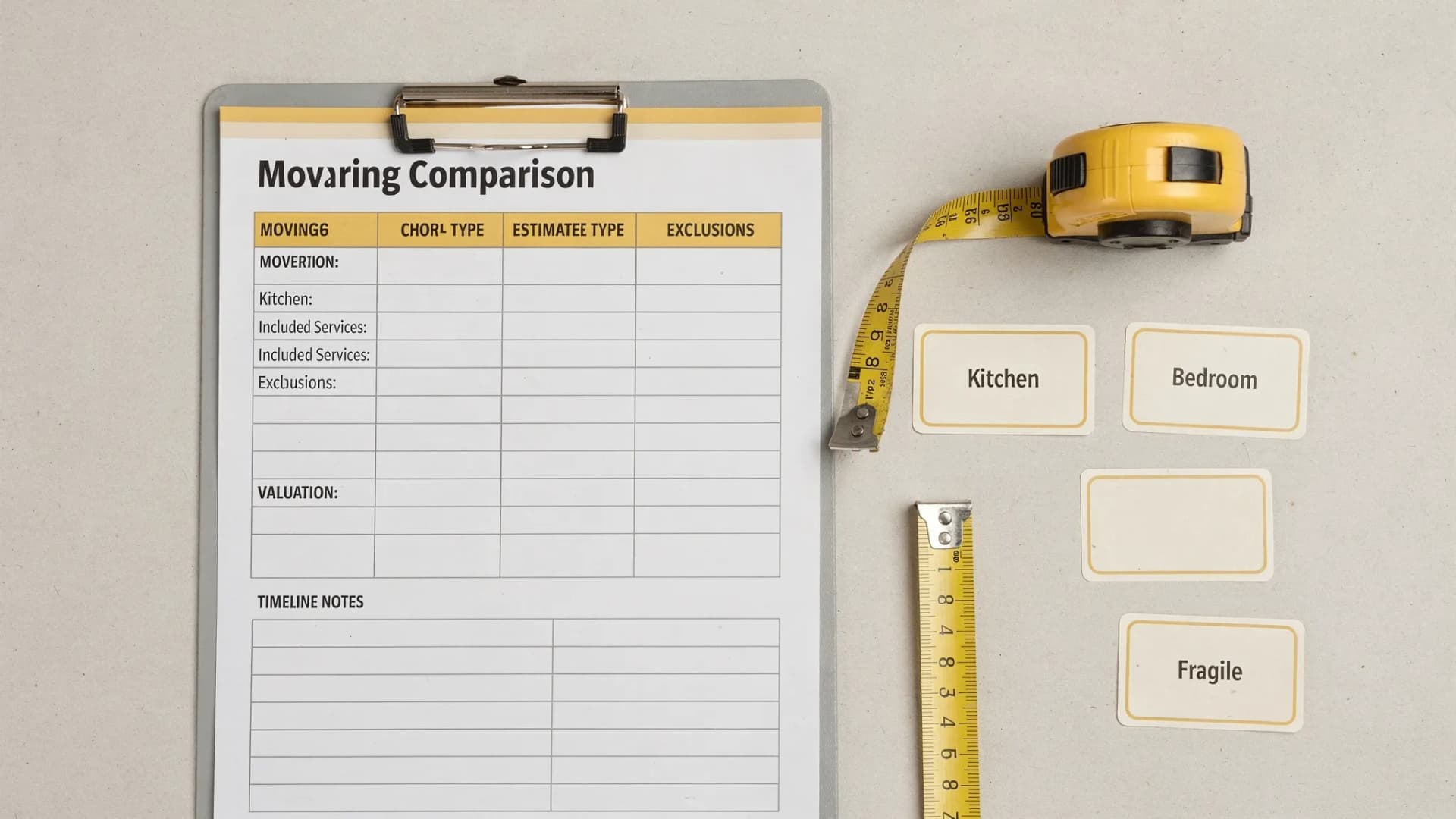
When one quote is $800 lower, it is usually because the scope is different, not because the mover is magically more efficient.
Send every mover the same notes:
Number of flights of stairs at pickup and delivery
Elevator reservation requirements
Parking distance expectations
Bulky items list
Packing responsibility (you vs. them)
Even a small access mismatch can produce large differences in labor time.
Packing can refer to:
Labor only (you provide materials)
Materials + labor (boxes, paper, tape included)
Fragile-only packing
Full home packing
Make the mover write it down in the estimate.
If you compare two quotes with different valuation/protection selections, you are not comparing price fairly. Confirm what protection is selected and what it covers.
You do not need to be an expert to reduce risk.
Cross-check:
License records (federal or state, depending on your move)
Business name consistency across estimate, website, and paperwork
Review patterns (recent, detailed reviews are more predictive than star averages)
A quick way to build confidence is to read a handful of “middle” reviews, not just 5-star and 1-star. They often reveal recurring issues like late arrivals, surprise charges, or communication gaps.
These reveal how the company behaves when something goes wrong.
“If the crew arrives and something in the scope is different, what happens next?”
“If an item is damaged, what is the step-by-step claims process?”
Good movers answer with a process. Risky movers answer with reassurance.
Relocation is physically demanding, and decision fatigue is real. If you are managing a move while juggling work, family, or health goals, keeping tabs on basics like sleep, hydration, and recovery can help you avoid burnout during packing week.
If you are already into data-driven health, some people use clinician-reviewed lab insights to monitor how stress and routine changes affect them. For example, biomarker testing and longevity programs can provide a structured snapshot (and action plan) if you want to track changes over time, especially around high-stress periods like a move.
After you normalize quotes, pick the mover that offers:
Clear, written scope with minimal ambiguity
Verified licensing and professional protection options
Strong communication and realistic scheduling
The service add-ons you actually need (packing, storage, specialty handling)
A total price that stays stable when assumptions are clarified
If you are torn between two companies, choose the one that is better documented. Paperwork clarity usually predicts move-day clarity.
How many relocation moving companies should I compare? Comparing 3 is usually enough to see the market range and spot outliers. More than 5 often adds noise unless your move is complex (multiple stops, storage, specialty items).
What should a written moving estimate include? It should state the service level, inventory assumptions, access assumptions, what is included, potential additional charges (and triggers), timing, and protection/valuation selection.
Is the cheapest quote ever the best choice? Sometimes, but only after you confirm the scope is identical. The biggest budget blowups happen when the lowest quote is missing access fees, packing details, or clear change-order rules.
How do I know if a mover is legitimate for California moves? Verify the company’s authority for your move type (interstate vs. in-state), confirm the business identity matches the paperwork, and insist on written estimates and documented protection options.
Should I pay a deposit to book a mover? Small deposits can be normal, but you should understand the cancellation and refund terms in writing. Be cautious with large deposits or pressure to pay in cash.
If you want a relocation team that prioritizes upfront honest pricing, careful handling, and reliable scheduling, Zapt Movers can help with residential, commercial, local, and long-distance moves, plus packing, storage, and specialty items.
Get started here: Zapt Movers (request a free quote and we will help you scope the move so your estimate stays predictable).